GSAP Online Exam
Sit the examThe Green Star Accredited Professional (GSAP) Exam tests participants' comprehension and application of Green Star, as well their understanding of green building practices in Australia.
We recommend that you take the exam within a few weeks of doing the course to ensure that your knowledge is fresh.
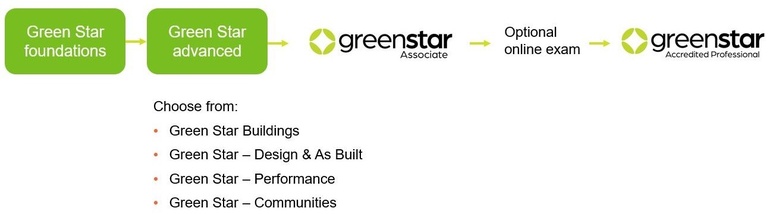
How to become a Green Star Accredited Professional
- Step 1: Complete the Green Star Foundation Course
- Step 2: Pass the Green Star Accredited Professional Online exam
- Step 3: Register for the CPD program and pay a biennial fee
- Step 4: On initial joining of the CPD program, provide documentation describing your involvement in Green Star or green building project/s over the past two years (clearly identifying the Green Star or green building project/s and your role in them), and signed by your client, supervisor, project manager or other suitably qualified persons.
To retain your GSAP status you will have 2 years to:
- Complete the Green Star Refresher Course (a free online course worth 2 CPD point)
- Complete 30 points of 'sustainability' education' which must include 10 points of GBCA education/events
The exam
You can sit the GSAP online exam at a convenient time at home or work. The exam is 'open book' - but is timed, which means you must complete the exam within 2 hours and in one sitting.
The exam consists of 100 multiple-choice questions, with a focus on practical application as well as theory. A mark of 75% must be achieved to pass the exam.
To prepare for the exam.
We strongly encourage you to read over your Green Star Foundation Course workbook and purchase and study a copy of one of the following technical manuals:
- Green Star - Office Design and Office As Built v3
- Green Star - Education v1
- Green Star - Retail Centre v1
- Green Star - Healthcare v1
- Green Star - Multi Unit Residential v1
As a GSAP training participant, you are entitled to a $100 discount on your purchase of any technical manual (valid for one month after your course completion date). Visit the GBCA online store to purchase your technical manual.
Your course workbook and access to information located on our website will be a useful tool during the exam.
Some exam questions may require you to search for additional information in order to answer the question. To assist you to answer these questions you will need to ensure you have the following resources downloaded from our website:
- Technical Clarification and CIR Rulings (General) This document may assist you in answering exam questions relating to the Green Star Office v2 rating tool. Please note that this document is not supported on Office 2008 on Mac OS X.
- Green Star Certification Process
- Green Star Submission Requirements (Round 2)
Exam cost
The exam is administered directly through the Green Building Council of Australia and costs just $150 per exam. This fee is in addition to your course fee.
Passing the exam
Once you've completed the exam, you'll know immediately if you have passed. If you fail, you can choose to resit the exam at a convenient time by simply re-registering and paying again.
When you've passed the exam, you will be able to apply to become a GSAP through the CPD program.
If you fail on your first sitting, you can choose to resit the exam at a convenient time by simply re-registering and paying the $150 exam fee again. You can either sit the exam immediately, or return to your user profile at a more convenient time.
Sample Questions
1. One point can be awarded for "Provision of Car Parking" Credit if the number of car spaces is:
a. 25% less than maximum local planning allowances
b. 25% less than minimum local planning allowances
c. 10% less than minimum local planning allowances
d. Not exceeding the maximum local planning allowances by more than 10%
2. Which Environmental impact category has the highest Weighting?
a. Indoor Environmental Quality
b. Water
c. Energy
d. All of the above environmental impact categories have the same Environmental Weighting
3. Which calculator(s) are required for the 'Discharge to Sewer' credit:
a. Sewerage and Potable Water
b. Energy and Sewerage
c. Change in Ecology and Sewerage
d. Change in Ecology and Potable Water